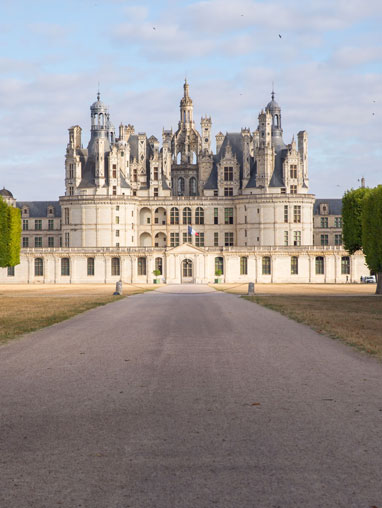
The salamander is everywhere at Chambord. More than three hundred depictions of the little amphibian punctuate the castle, set into coffered ceilings, sculpted on walls, and worked into stone vaults. This relentless repetition is no decorative whim. It is a royal signature, the personal emblem chosen by François I, who left his mark on the building he loved above all others.
In the wild, the salamander is a modest animal, an amphibian roughly eight inches long. Yet the king elevated it into a powerful symbol of his reign, and visitors today can turn the search for it into a game, counting the crowned figures hidden throughout the rooms.
The legend of the fire-proof salamander
The salamander owes its reputation to the medieval bestiaries, the illustrated books in which the animals of the world were described and given moral meaning. According to these texts, the salamander could survive flames. The belief had a practical, if mistaken, origin. When logs and stumps were gathered and thrown onto the hearth to burn, a salamander sometimes hiding inside would emerge unharmed, its moist skin protecting it for the brief moment it took to escape the fire.
From this observation grew the conviction that the creature was master of the flames, able to live within fire and even to control it. For a Renaissance prince, no image could have been more flattering.
Why François I chose the salamander
François I adopted the salamander as his personal emblem and had it carved across his residences, from Fontainebleau to Chambord, where it appears in greater number than anywhere else. The animal embodied qualities a king wished to claim for himself, mastery over danger and the power to protect his people.
At Chambord the salamander is crowned, a clear declaration that the creature stands for the sovereign. Above it runs the royal motto, Nutrisco et Extinguo, which can be translated as I feed on the good fire and I put out the bad. The phrase captures the dual role the king assigned himself, nourishing what is good in the realm while extinguishing what threatens it.
Reading the symbol: water and flame
The crowned salamander of Chambord is often shown in one of two attitudes. In the first it spits drops of water to put out the bad fire, the destructive flame that must be quenched. In the second it swallows flames to feed on the good fire, drawing strength from what is virtuous. Together the two gestures make the salamander a perfect emblem for a protective ruler, one who sustains his kingdom and defends it at the same time.