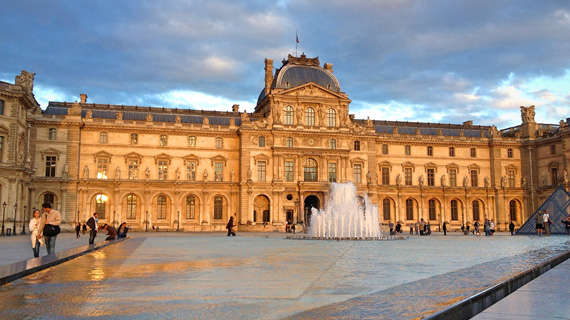
Before stepping inside one of the world's great museums, take a moment to linger in the Cour Napoleon. Beneath the glass Pyramid lies a story that spans centuries, kings, emperors, and presidents. Extime Travel invites you to look closer at this courtyard, where French architecture and modern audacity meet in perfect harmony, and where every façade carries the memory of another era
Over the centuries, the Louvre has been reshaped again and again by the rulers who left their mark on it. The building began as a fortress, raised to guard Paris against attacks from the Seine. This imposing medieval stronghold protected Parisians and long served a purely military purpose. Little by little, the old citadel gave way to the palace we know today, sometimes extended and even joined to the Palais des Tuileries, sometimes stripped of its outbuildings. It was during the museum's enlargement that the Cour Napoleon finally took shape.
The new Louvre undertaken by Napoleon III was organized around a central space: the Cour Napoleon.
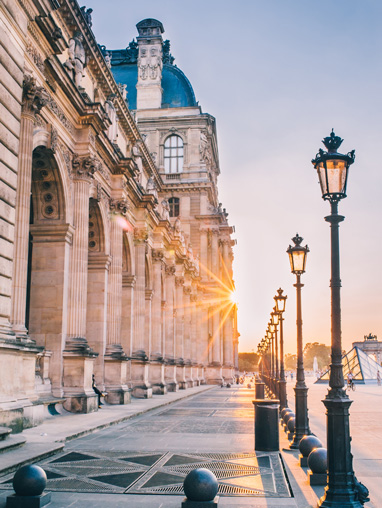
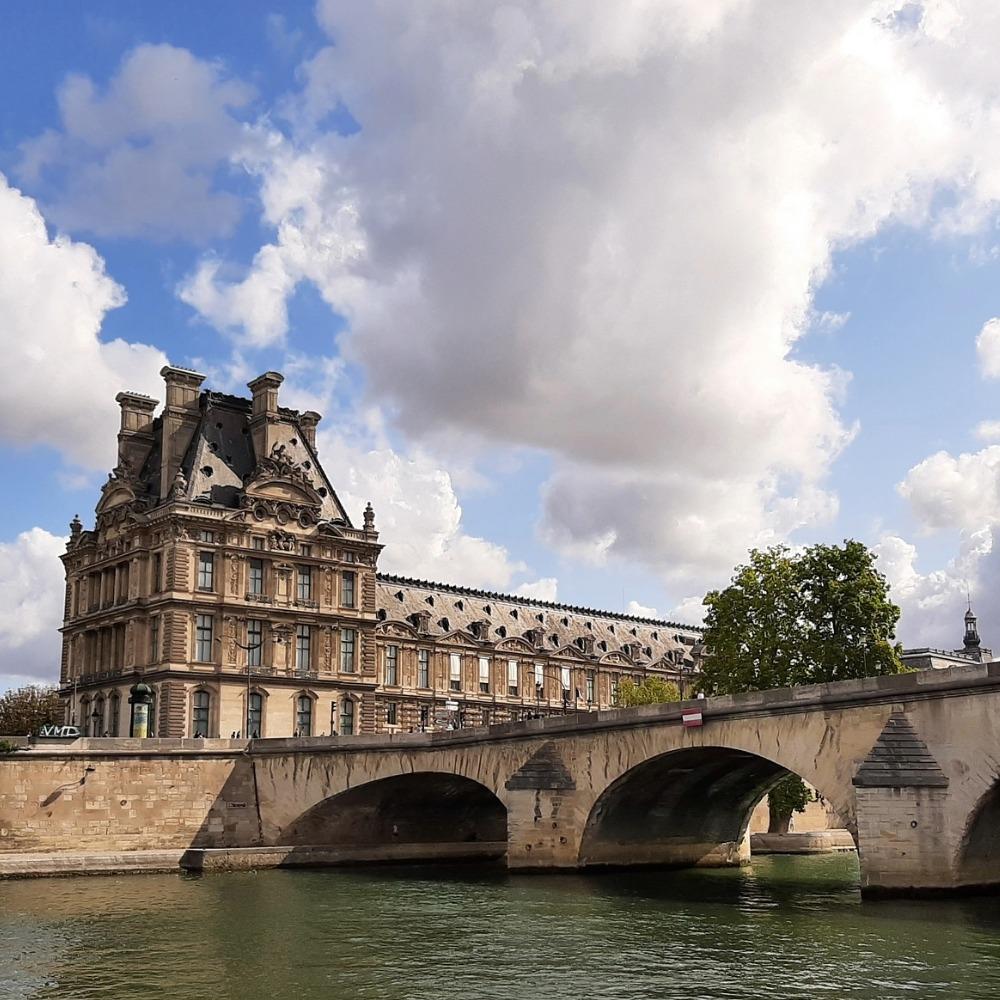
The emperor's project was begun by Visconti in 1852 and completed by his successor, Hector Lefuel, in 1857. Lefuel created the Cour Napoleon by raising two new wings, punctuated by pavilions set between pediments and dormer windows. For these buildings, he conceived an entirely new style of decoration, a distillation of every chapter in the history of French art.
Monumental sculptures stand at the corners of the courtyard. One, at the northeast angle, was carved by Antoine-Auguste Préault and represents Peace. The other, at the southeast angle, represents War. In 1926, Henri Verne, newly appointed director of the Musées Nationaux, launched a plan to reorganize the Louvre's collections, known as the Verne plan. It was then that architects recognized the need for a single entrance to the museum.
That vision would only be realized under the presidency of François Mitterrand, to whom we owe the famous Louvre Pyramid. Long criticized for its modernity, it is now inseparable from the museum itself.
The Grand Louvre project, an extension of the Verne plan, was set in motion by François Mitterrand in the 1980s.
The new Cour Napoleon, which became the museum's main entrance, was inaugurated in 1989. At its heart now rises the vast Pyramid, built from glass lozenges. The structure was designed by architect Ieoh Ming Pei, who worked on it for four years, from 1985 to 1989. The result is striking: roughly 72 feet tall, 98 feet wide, and supported by 95 tons of stainless steel girders, a feat of engineering that still feels weightless to the eye.
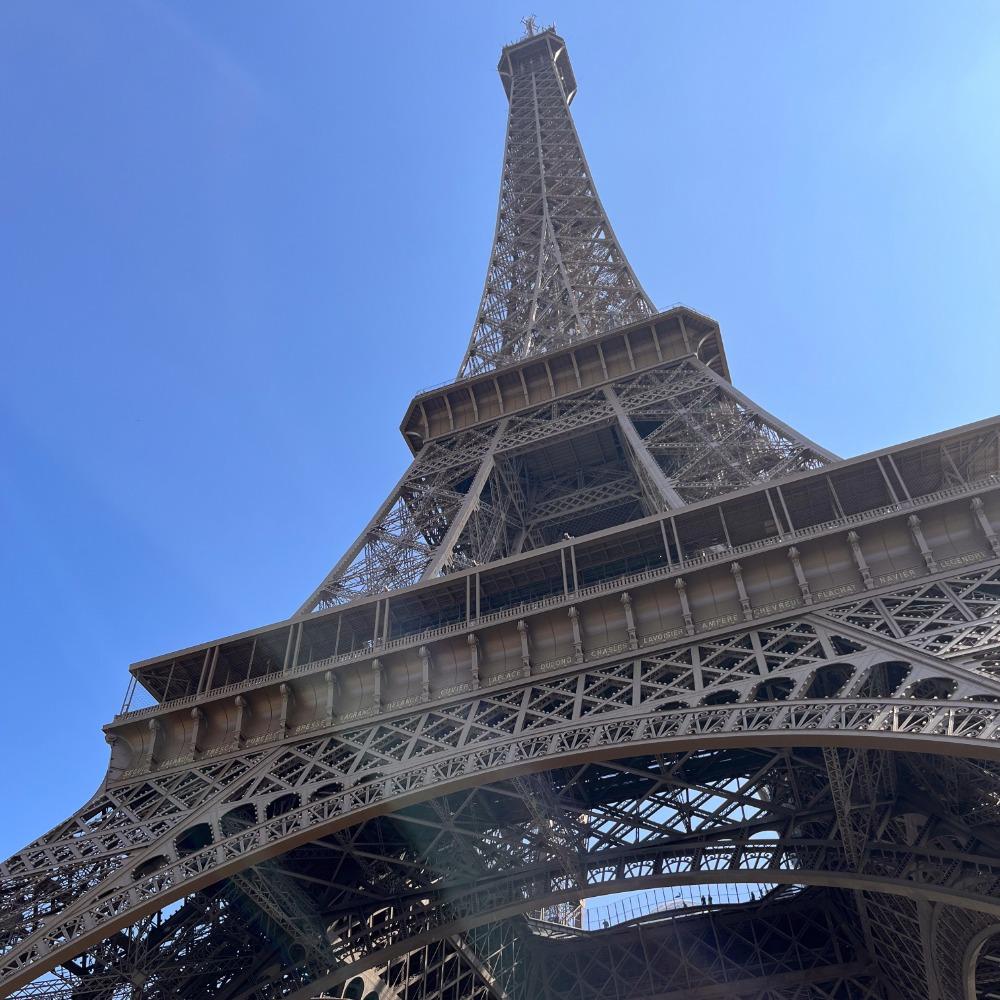
At first, the Pyramid was far from unanimously embraced by Parisians and visitors alike. Its geometric lines were judged too sharp against the older wings of the museum, especially the galleries decorated by Lefuel. Over time, the great Pyramid became the emblem of the Louvre. Today, this glass landmark is wholly part of the museum and of Paris itself, appearing in depictions of the capital nearly as often as the Eiffel Tower.
In June 2016, artist JR made the Louvre Pyramid vanish. Using a trompe l'oeil installed across its surface, he caused Pei's creation to dissolve entirely into its surroundings. Visitors had only to look toward the museum, set on the main axis along the central avenue of the Tuileries Garden, for the Pyramid to disappear from view.
So when you walk across the Cour Napoleon, just before entering the museum to discover some of the finest masterpieces in the world, spare a thought for its story, one that began in the nineteenth century and continues to unfold with every visitor who crosses it.