A refuge for the queen
The highly codified customs of the court wearied Marie-Antoinette, so the young queen liked to retreat to the Petit Trianon, which her husband Louis XVI had given her shortly after his accession to the throne. Having first redeveloped its park, she commissioned her architect Richard Mique to extend the garden to the north and to build a small hamlet evoking a Norman village.
A village in miniature
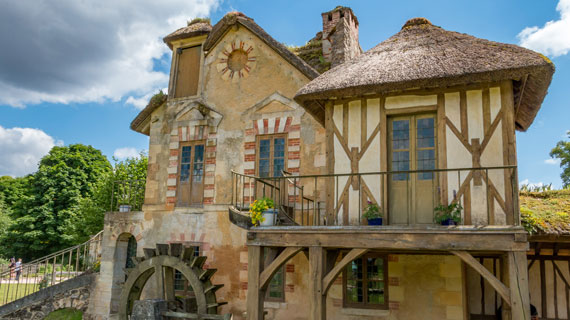
The Queen's Hamlet, made up of about a dozen cottages with thatched roofs, formed a genuine little farm where the queen loved to take long walks and to receive her closest friends. Around the Malborough tower that overlooks the pond stand the buildings reserved for Marie-Antoinette and her guests, among them the Queen's House, a boudoir, a billiard room, and the mill. Other cottages were given over to farm work, including the barn, now gone, the dairy, and the farm itself, with its cowshed and henhouse.
Restored across the centuries
Once an emperor, Napoleon I ordered a first restoration in 1810, but it was only in the early twentieth century that the Hamlet recovered its full splendor, thanks to the Rockefeller donation that funded a complete restoration. A further restoration in the late 1990s led to the reopening of the domain and the Hamlet to the public. On a visit to Versailles, a stroll through the Queen's Hamlet is not to be missed.